
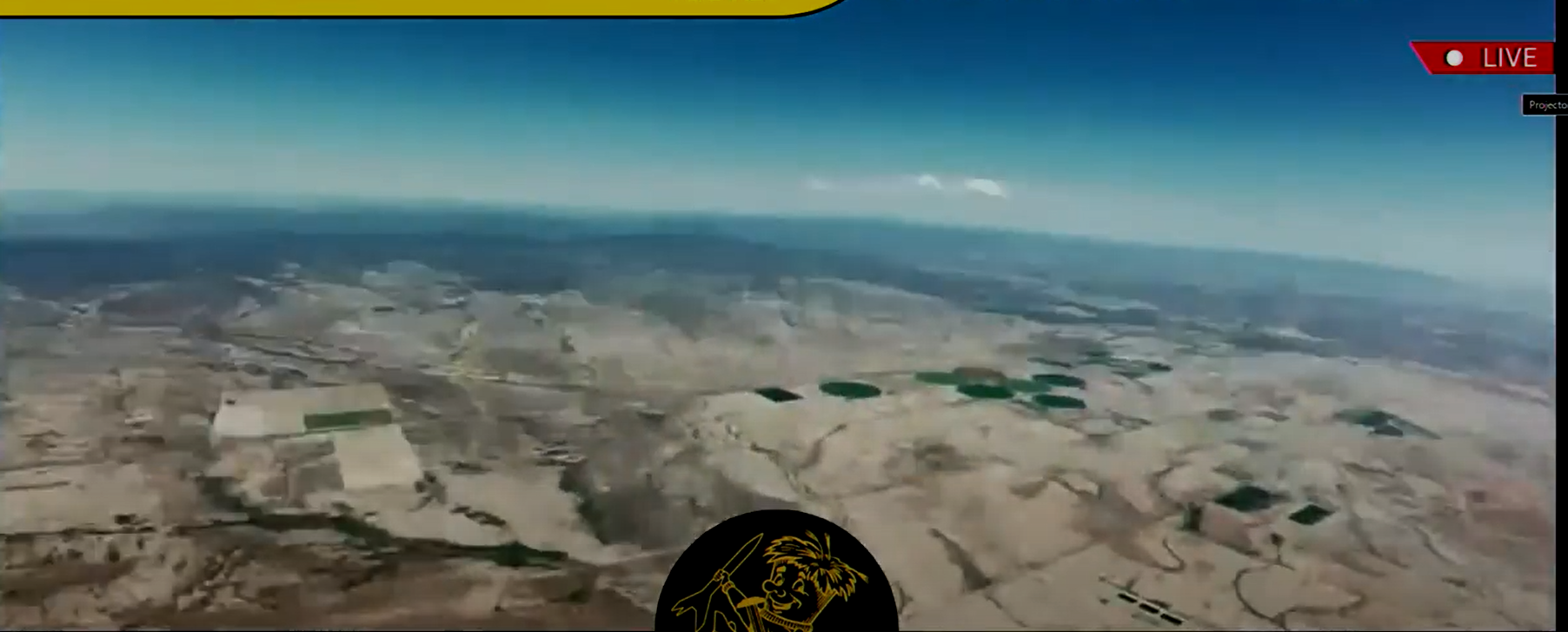
Live Rocket Video Challenge
Live Rocket Video Challenge
ESRA will again be live streaming the 2026 IREC! We are always seeking new and better ways to showcase our teams. To that end, we are creating a challenge for teams to provide LIVE content during their launches! Teams will provide video from onboard their rockets and visualize their telemetry to help audiences understand what is happening and showcase the spectacle of rocketry.
2025 Live Rocket Video Challenge Winner
Best onboard Footage
2025 IREC - Livestream Rocket Video Challenge - Wichita State University -Team 193 - Ad Astra - Caleb Perkins
2024 Live Rocket Video Challenge Winner
View all 2024 IREC Live Rocket Challenge Video Submissions: Here
Due to the increased number of teams, and changes in the frequencies available for video transmission relative to last year, some teams wishing to participate in the Live Rocket Video Challenge may be unable to do so. Consequently, for this year only, we have altered the rules and requirements for the challenge as follows.
Changes to note:
ESRA plans to broadcast Live Rocket Feed videos on the livestream as was done last year. However, videos that can’t be transmitted “Live” will instead be shown on a delayed basis.
All teams participating in the Challenge must have the capability to transmit live video and will be required to check in with the Media Team during one of the two days at the Horseshoe Pavilion to demonstrate that capability. Teams that successfully meet this requirement will qualify for the Challenge even if they are later unable to transmit live video.
All teams must save footage onboard the rocket and provide said footage to the Media Team at the Post Flight Data Inspection/Check-in or other designated area, even if you were successfully able to transmit video during your flight.
Only teams using a designated frequency allocated for video will be allowed to attempt to stream Live Rocket Feed to their own devices during their respective launches. However, this does not negate the onboard saved footage requirement, which is applicable to all participating teams.
ESRA highly recommends incorporating the capability of turning on and off their transmitter as not to conflict with other teams or ESRA equipment. Teams are NOT ALLOWED to attempt transmission at any other time at the launch site. Failure to follow this restriction will result in dismissal from the Live Rocket Challenge and will lead to a loss of overall competition points
Deliverables Applicable to All Participating Teams:
Teams will demonstrate the ability to transmit live video to the Media Team during conference days, Monday, June 15th and Tuesday, June 16th, 2026.
Teams will save their live video feed onboard their rocket.
Teams will deliver their full Live Rocket Video to the Media Team directly following their Post Flight Data Inspection/Check-in via a team-provided SD Card at the highest export resolution possible.
Teams shall use their locally sourced video to provide a highlight clip up to 60 seconds long, no later than Saturday, June 20th at 6:00 AM CST.
Audio is supported but not required. Any prepared audio must have rights secured (i.e., not trigger YouTube ContentID detection).
Content shall include any combination of these video types:
Live video from onboard the rocket
Visualization of live rocket telemetry
Visualization of live GSE telemetry (e.g. hybrid or liquid fill process)
The two award categories are:
Best Onboard Video
Best Telemetry Visualization
ESRA may elect to combine these two award categories into a single award category for the 2026 Event.
Judging Criteria:
For maximum score, the Judging Criteria are:
The teams must showcase their HAM Call Sign in some manner, ideally on the video itself, if they are planning to transmit on a licensed frequency band. This requirement applies if the team is unable to transmit live. Most of the allocated frequencies for Video will require a HAM license (reference the Radio Frequency Band Plan below).
The content will communicate what is happening on screen to viewers of all expertise levels.
The content will showcase views never before seen in rocket competitions
The content will be visually appealing with consistent visual identity
The team identity will be clear throughout
The content will avoid profanity or other inappropriate content
The stream will be free of interruptions, freezes, stutters, and drops
The stream will have minimal latency, when applicable.
The stream will be free of music triggering YouTube demonetization
The submission will be complete. It will include confirmation of livestream capability prior to launch day, the recorded stream, and the highlight clip.
Judging Procedure:
A committee of ESRA Livestream and Media personnel will review all elements of the submissions and determine the winners. The winners will be the Judging Committee’s subjective consensus on which submissions best meet the letter and spirit of the Judging Criteria.
Implementation Rules:
This update references the frequencies that are allocated for video (i.e., the Frequency Band Plan below). Note that certain unlicensed frequency bands, specifically 5.8 and 2.4 GHz, are not readily available for team video. Therefore, for the purpose of the Live Rocket Video Challenge only, teams may have their radio equipment operated under the license of their FoR or Mentor, if said persons are willing to provide that service. In any case, the Call Sign of the operator shall appear in the video of any team planning to transmit on a licensed frequency. Note that an FoR, Mentor, or an ESRA Volunteer, can serve as the operator during the equipment demonstration during the conference days.
The Frequency Band Plan developed by ESRA is a plan, but is not an Authorizing Document. Teams must still follow any and all FCC regulations, regardless of what is contained in the Plan.
Teams not using approved frequency ranges will be ALLOWED to attempt to transmit during their respective launches as long as they have the ability to cut on and off their transmitter as not to hinder other teams or ESRA equipment. Teams using unapproved frequencies may not turn on their transmitters outside their launch window at any time at the launch site. Failure to follow this restriction will result in dismissal from the Live Rocket Challenge and will lead to a loss of overall competition points.
Additionally, we will only be allowing a certain number of teams on select frequencies the ability to launch during a given salvo to limit interference. This means your team may be queued and required to wait until a later salvo.
Questions and Feedback:
This is a newer challenge and ESRA is learning too, hence the change for 2026. Teams are encouraged to ask questions and provide feedback on the Official ESRA Discord. Teams should also state their intent to participate in the challenge by Progress Report 3. This will help ESRA prepare for the correct number of participants. Teams are able to withdraw until 5:00 PM CST June 16, 2026. Please send an email to media@esrarocket.org if you wish to withdraw.
How to submit:
ESRA will provide a location during conference days for students to confirm Live Rocket Video Feed capabilities prior to launch days.
On launch days, ESRA will provide
a video download point in the Post Flight Data Inspection/Check-in area,
a livestream connection point for applicable teams,
and an upload point for the 60 second video submission. The Dropbox link is available on the Live Video Submission page under your teams account.
The following resolutions and frame rates are supported:
Live Stream - Preferred
1080p60
Live Stream - Supported
1080p29.97
1080p30
1080p25
4K60 (HDMI only)
4K30 (HDMI only)
4K29.97 (HDMI only)
4K25 (HDMI only)
Local Recording - Preferred
4K60
Local Recording - Supported
4K29.97
4K30
4K25
1080p60
1080p30
1080p29.97
1080p25
Teams must record their video feed onboard the rocket and provide it to ESRA at Post Flight Data Inspection/Check-in. For teams unable to transmit live video, the onboard feed will be shown on a delay via the Livestream. Failure to provide a usable copy of the feed at Post Flight Data Inspection/Check-in will result in removal from the Live Video Feed challenge.
Teams must provide their own SD Card or USB Hard Drive for immediate and direct file transfer onto an ESRA provided Windows computer or drive at the Post Flight Data Inspection/Check-in point or other designated area. Once downloaded, team hardware will be immediately returned to the teams.
Teams shall produce a highlight clip of up to 60 seconds long. No editing beyond cutting the clip is permitted. Multiple cuts are acceptable, but the footage must remain in order. The recorded feed and clip must be in a commonly used file format, much as MP4. The purpose of the highlight clip is to allow ESRA to easily play a short clip during the award ceremony. To submit the recordings, teams shall submit via internet using the form provided in the Accepted Teams section of the ESRA Website.
Use the file naming conventions listed below.
Include copyright clearance procedures:
If any license or copyright clearance procedure is required to avoid YouTube ContentID detection, that license or procedure MUST be included in the submission. Text files with title Team ### - Audio Copyright Info - [Project Name] is recommended. Any licenses must be transferable to ESRA and allow use on YouTube and social media.
Highlight Clip Submission Link: Drop Box link on the Live Video Submission page under your team’s account.
Make sure your filenames match the examples below by replacing the ### with your team number and everything in the brackets, including the brackets [], with your team number.
Team ### - LIVE CLIP - 4K - [Project Name]
Team ### - LIVE RECORDING - 1080p - [Project Name]
These are for ease of Livestream and Awards Ceremony Use.
Highlight Videos:
Videos should be submitted as early as possible, but no later than 2359 local time on Friday, 19 June 2026. This means you must launch before the last day.
Remedies for audio copyright issues:
If YouTube detects any ContentID audio copyright matches, ESRA may elect to mute all audio for the duration of the issue. A If YouTube detects any ContentID matches with your submitted audio, and you have not provided a suitable license, you will be disqualified from winning an award.
**ESRA and Hosting Partner will have non-exclusive rights to all submissions**
This means you can still use and share them, and you will still own them, but we can use them on any media platforms in present and future, and those mediums that do not yet exist. We can also share with our sponsors, allowing them to share on their media platforms. We will not sell for profit, but the organizations and sponsors using the footage will benefit in the form of advertising their companies and organizations.
ESRA Frequency Band Plan | Live Video Challenge Briefing PPT
Live Video Challenge Rubric PDF
2025 Live Rocket Video Challenge Winner
Best Live Telemetry
2025 IREC - Livestream Rocket Video Challenge - Worcester Polytechnic Institute - Team 194 - Elysium - Nic DeBruin
View all 2025 IREC Live Rocket Challenge Video Submissions: Here